


 NEWS DESK
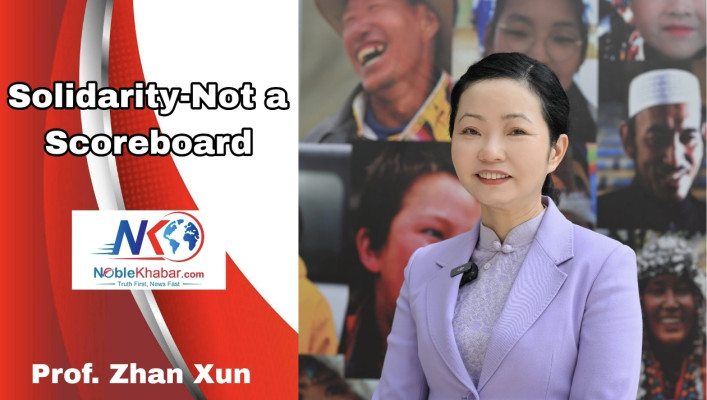
Solidarity-Not a Scoreboard : Prof. Zhan Xun
Nepal is facing a humanitarian tragedy. Lives have been lost, families have been torn apart, communities have been devastated, and rescue workers are still struggling against time. Countries around the world are responding with money, emergency supplies, rescue personnel, transportation, technology and technical expertise.
At such a moment, there should be one priority: save lives, relieve suffering and help Nepal recover.
Yet amid this tragedy, an ugly and deeply irresponsible narrative has begun circulating, particularly on social media: which country gave more, which gave less, and therefore which country is supposedly a “better friend” of Nepal.
This is humanitarian assistance, not an international auction. It is solidarity—not a scoreboard.
Ranking countries according to the absolute dollar amount of their assistance is fundamentally misleading. Humanitarian contributions come in different forms. One country may provide cash; another food, tents and medicines. Others may send aircraft, engineers, rescue specialists, satellite imagery, meteorological information or equipment that Nepal urgently needs. Some assistance arrives immediately; other commitments support reconstruction months or years later.
How can all of this honestly be reduced to a single number?
More troubling is the damage such rankings can cause.
If every country offering assistance is immediately put on a scoreboard—praised for giving more or ridiculed for giving less—why should smaller countries or those with fewer resources feel encouraged to contribute?
Imagine telling a country that sends what it can afford that its assistance is insignificant because another country gave more. Imagine telling rescue specialists risking their lives in dangerous conditions that their contribution matters less because it cannot easily be converted into dollars.
That is not humanitarianism. It is cynicism disguised as arithmetic.
Nepal needs more countries to help, not fewer. It needs more rescue workers, more food, more tents, more medicine, more technology and more reconstruction assistance. Anything that discourages international participation ultimately harms Nepal itself.
Even more irresponsible is the attempt to turn these rankings into geopolitical insinuations: Country A gave more than Country B, therefore A cares more about Nepal; Country B gave less, therefore its friendship with Nepal should be questioned.
Such claims should be treated with the suspicion they deserve.
Regardless of where they originate, those who deliberately exploit a national tragedy to sow distrust between Nepal and countries extending a helping hand are not serving the interests of disaster victims. They are exploiting human suffering to manufacture political division.
And Nepal could ultimately pay the price.
Nepal will require extensive international assistance not only today, but for months and probably years. Roads and bridges must be restored. Homes and livelihoods must be rebuilt. Hydropower and communications infrastructure must recover. Disaster monitoring and early-warning capabilities must improve.
Why would anyone who genuinely cares about Nepal want to turn its international friends against one another?
The sensible principle is simple: every country should contribute according to its capacity and Nepal’s actual needs, while rescue and relief efforts should be coordinated according to the priorities and arrangements of the Government of Nepal.
Some countries have money. Others have specialised rescue teams. Some have aircraft and logistics capabilities. Others possess satellite, meteorological, hydrological or engineering expertise. Nepal needs all of them.
There is an old Chinese saying: “When everyone adds firewood, the flames rise high.” There is another: “Do not refrain from doing a good deed simply because it is small.”These ideas capture what humanitarian assistance should mean.
China’s assistance should be understood in precisely this broader context. China is not simply donating money; as Nepal’s neighbour, it is participating in rescue, recovery and long-term disaster prevention. Cash is only one component. Emergency supplies, professional rescue expertise, transportation capacity, scientific and technical support, reconstruction and future cross-border disaster prevention also matter.
The same standard should apply to every country helping Nepal. A dollar from one country does not become more humanitarian than a dollar from another. A rescue worker from one country does not save a more valuable life than a rescue worker from another.
There will be time later to examine how effectively international assistance was delivered and whether resources reached those who needed them. Accountability matters.
But that is entirely different from turning generosity into a geopolitical horse race.
While families are mourning, people remain missing and rescuers are searching through mud and debris